
Let’s be honest—life has a way of humbling us.
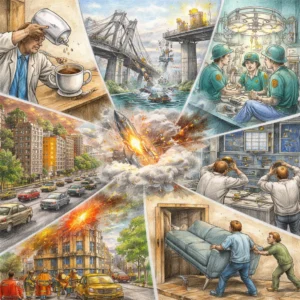
One minute you’re confidently pouring what you think is sugar into your coffee… and the next, you’re sipping salted regret. Or maybe you once stood proudly in front of your front door, convinced that yes, that oversized IKEA sofa would absolutely fit through. (It didn’t. It never does.)
These little “Oops” moments? They make great stories later.
But now imagine those same mistakes happening on a much larger scale.
A bridge collapsing.
A spacecraft malfunctioning mid-flight.
A surgical procedure going wrong.
Suddenly, “Oops” isn’t funny anymore—it’s catastrophic.
This is exactly where simulations step in as the quiet heroes behind the scenes. They allow us to test, fail, adjust, and perfect ideas in a safe, virtual world before bringing them into reality. Think of them as the ultimate safety net—one that catches mistakes before they ever happen.
Let’s dive into how simulations are changing the game—and why they might just be the smartest tool we have for navigating an unpredictable world.
1. The Ultimate “What If” Machine
Humans are naturally optimistic. We like to believe things will work out. That a structure is “probably strong enough.” That a system “should handle the load.”
But “probably” doesn’t cut it when lives and millions of dollars are on the line.
This is where simulations shine.
They don’t rely on gut feelings. They don’t get tired or make assumptions. Instead, they use mathematical models, physics, and data to explore every uncomfortable “what if” scenario we’d rather avoid thinking about.
- What if a category 5 hurricane hits this coastal building?
- What if a cooling system fails during peak operation?
- What if millions of users log into a platform at the exact same second?
Simulations force us to confront these possibilities before they become real problems.
They essentially shift failure from the real world—where it’s expensive, dangerous, and sometimes irreversible—into the digital world, where it’s fixable.
Instead of saying, “Let’s hope this works,” simulations allow us to say, “Let’s prove it works.”
2. Failing Fast (Without Burning Money)
You’ve probably heard the phrase: “Fail fast.”
It sounds inspiring… until you realize that real-world failure can be incredibly expensive.
Imagine building a full-scale prototype of a jet engine, only for it to explode during testing. That’s not just a failure—that’s millions of dollars gone in seconds.
Now imagine testing that same design using simulations.
You can:
- Run hundreds of variations
- Adjust materials instantly
- Test extreme conditions repeatedly
- Identify weaknesses early
All without physically building a single component.
That’s the beauty of simulations—they make failure cheap, fast, and productive.
Instead of fearing failure, teams can embrace it. They can experiment more freely, push boundaries, and explore bold ideas without the risk of massive losses.
Out of hundreds of failed attempts, one breakthrough design can emerge—and that’s often all it takes to change an entire industry.
3. Training for the Unthinkable
Have you ever wondered how pilots remain calm during turbulence or emergency situations?
It’s not because they’re fearless.
It’s because they’ve already lived through it—virtually.
Flight simulators allow pilots to experience:
- Engine failures
- Extreme weather conditions
- Emergency landings
- System malfunctions
…over and over again, in a controlled environment.
By the time a real emergency happens, it’s no longer unfamiliar. It’s just another scenario they’ve practiced.
And this doesn’t stop at aviation.
Simulations are widely used in:
- Healthcare: Surgeons practice complex procedures on digital models
- Energy: Operators train for system failures and blackouts
- Military: Teams prepare for high-risk missions
- Disaster response: Emergency teams rehearse evacuation and rescue strategies
In all these cases, simulations build something incredibly valuable: confidence through preparation.
They transform fear into familiarity.
4. The Power of Digital Twins
Now let’s talk about one of the most exciting advancements in simulations: Digital Twins.
Imagine you build a bridge—not just physically, but digitally as well.
This digital version is an exact replica of the real structure, constantly updated using real-time data from sensors placed on the bridge.
If the wind picks up…
If traffic increases…
If materials begin to wear down…
…the digital twin knows.
Engineers can then run simulations on this virtual model to predict future behavior.
- Will the structure weaken under prolonged stress?
- Is maintenance required soon?
- Could a failure occur if conditions worsen?
This allows for predictive maintenance—fixing problems before they happen.
Instead of reacting to failures, we start preventing them.
And this concept isn’t limited to bridges.
Digital twins are being used in:
- Smart cities
- Manufacturing plants
- Healthcare systems
- Supply chains
It’s like having a crystal ball—but powered by data instead of guesswork.
5. Simulating Society Itself
Simulations aren’t just about machines and structures—they’re also about people.
Our world is full of complex systems driven by human behavior. And predicting that behavior? That’s incredibly difficult.
But simulations are making it possible.
They’re used to model:
- Disease spread across cities
- Traffic flow during major events
- Public transportation efficiency
- Economic responses to policy changes
For example, during health crises, simulations help predict how a virus might spread, allowing governments to plan interventions.
In urban planning, they help design cities that reduce congestion and improve quality of life.
In business, they help companies understand how customers might react to changes in pricing, products, or services.
In short, simulations allow us to “test drive” decisions before making them in real life.
6. Why Simulations Matter More Than Ever
We’re living in a world that’s more complex and interconnected than ever before.
A small mistake can ripple across systems, industries, or even entire countries.
At the same time, innovation is accelerating.
We’re building smarter cities, faster machines, and more advanced technologies—but with that comes greater risk.
Simulations act as a buffer between ambition and disaster.
They allow us to:
- Move faster without being reckless
- Innovate without unnecessary risk
- Learn from failure without real-world consequences
They give us the freedom to explore bold ideas—while keeping us grounded in reality.
The Motivational Reality Check
Here’s the truth: failure isn’t going anywhere.
No matter how advanced we become, mistakes will always be part of the human experience.
But simulations teach us something powerful:
Failure isn’t the enemy—unpreparedness is.
By using simulations, we’re not trying to eliminate failure completely. Instead, we’re choosing where and how failure happens.
We move it into a safe space.
We learn from it.
We improve because of it.
It’s a mindset shift.
Instead of fearing the unknown, we explore it.
Instead of avoiding risk, we understand it.
Instead of guessing, we test.
Final Thoughts: Your Own “Simulation Mindset”
You don’t have to be an engineer or scientist to benefit from simulations.
In everyday life, we use simplified versions of simulations all the time:
- Budgeting with spreadsheets
- Planning timelines
- Testing business strategies
- Visualizing outcomes before making decisions
Even thinking through “what if” scenarios is a form of mental simulation.
So the next time you’re facing a big decision—whether it’s launching a project, starting a business, or making a life change—pause and ask:
- What could go wrong?
- What scenarios haven’t I considered?
- How can I test this idea safely first?
Because the more you simulate, the less you gamble.
And in a world full of uncertainty, that’s a powerful advantage.
Conclusion
Simulations are more than just tools—they’re a way of thinking.
They help us prepare for the unexpected, learn from failure, and build smarter systems in every aspect of life.
From skyscrapers to surgeries, from cities to startups, simulations are quietly shaping a safer, more efficient future.
So go ahead—run the numbers. Test the scenarios. Embrace the virtual failures.
Because every mistake you catch in a simulation is one less disaster waiting in the real world.
References
National Aeronautics and Space Administration (NASA) – Simulation Technologies
MIT OpenCourseWare – Modeling and Simulation