
Have you ever looked at an amazing drawing and thought, “I wish I could do that,” only to pick up a pencil and create something that looks completely different from what you imagined?
If that sounds familiar, you’re not alone.
Almost every beginner artist has experienced the same frustrating cycle. Inspiration strikes. Confidence rises. A blank sheet of paper appears. Then reality arrives. The drawing doesn’t match the vision in your head, and suddenly you start questioning whether you’re creative at all.
Maybe you tried drawing your pet. Maybe it was a favorite coffee mug, a beautiful flower, or a landscape from your latest vacation. Whatever the subject was, the result probably didn’t look quite right. The proportions felt off. The perspective seemed strange. The details looked awkward.
At that point, many people come to the same conclusion:
“I guess I’m just not talented.”
The truth is far simpler.
Most people don’t quit drawing because they lack talent. They quit because they lack guidance.
This is where Sketching and AR are changing the game for aspiring artists around the world.
Augmented Reality (AR) is no longer just for gaming, social media filters, or futuristic gadgets. Today, it has become a powerful learning tool that helps beginners improve their drawing skills, understand proportions, and build artistic confidence from the comfort of home.
Instead of struggling alone, AR acts like a patient drawing coach that guides your hand while teaching your eyes how to see.
Let’s explore how Sketching with AR can help you overcome creative frustration and finally enjoy the artistic journey.
Why Learning to Draw Feels So Difficult
Drawing looks simple when experienced artists do it.
They effortlessly create realistic portraits, beautiful landscapes, and detailed illustrations while making it appear easy. What many beginners don’t realize is that drawing is actually a combination of several complex skills.
You must learn:
- Observation
- Hand-eye coordination
- Spatial awareness
- Proportion
- Perspective
- Light and shadow
- Muscle memory
Imagine trying to learn piano while simultaneously learning music theory and reading sheet music. That’s similar to what beginner artists experience.
The biggest challenge isn’t drawing lines.
It’s knowing where those lines belong.
Most beginners can physically draw a line. The difficulty comes from accurately placing it in relation to everything else on the page.
This is why a dog suddenly looks like a potato.
This is why faces appear uneven.
This is why buildings lean sideways.
The issue isn’t creativity. It’s visual accuracy.
The Childhood Secret We Forget
Think back to when you first learned how to write.
Did anyone hand you a blank page and expect perfect handwriting immediately?
Of course not.
You traced letters.
You followed dotted lines.
You copied examples.
You practiced repeatedly until the movements became natural.
Tracing wasn’t considered cheating.
It was considered learning.
Yet somehow, when adults decide to learn drawing, they often believe they should instantly create artwork from scratch.
That expectation creates unnecessary pressure.
The reality is that artists throughout history have used references, guides, grids, and tracing methods as learning tools.
AR simply brings those traditional methods into the modern world.
What Exactly Is AR Sketching?
At first, AR drawing might sound complicated, but the concept is surprisingly simple.
Imagine placing a blank sheet of paper on your desk.
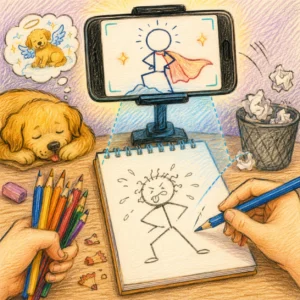
You position your smartphone above the page and open an AR drawing application.
Through your phone’s camera, a digital outline appears on top of your paper. The image stays aligned while you draw, creating a guide that helps you place your lines correctly.
You still use a real pencil.
You still draw on real paper.
You still develop real artistic skills.
The difference is that AR provides visual assistance that reduces guesswork and frustration. Modern AR drawing platforms allow users to project templates and practice tracing while learning proportions, structure, and drawing fundamentals.
Instead of wondering where to start, you have a clear roadmap.
How AR Helps Beginners Build Drawing Confidence
One of the biggest obstacles in Sketching is confidence.
Many people quit after only a few attempts because their expectations don’t match their current skill level.
AR helps bridge that gap.
When beginners successfully complete a drawing, they experience a sense of accomplishment that motivates them to continue practicing.
Confidence creates consistency.
Consistency creates improvement.
Improvement creates enjoyment.
And enjoyment keeps people drawing.
This positive cycle is one of the reasons AR-assisted drawing tools continue to grow in popularity among new artists.
1. AR Eliminates Blank Page Anxiety
Few things are more intimidating than a completely blank sheet of paper.
Every mark feels important.
Every line feels permanent.
Every mistake feels huge.
This pressure often causes beginners to freeze before they even begin.
With AR, the first step is already provided.
You know where to start.
You know where the major shapes belong.
You can focus on drawing instead of worrying.
The blank page becomes a creative opportunity rather than a source of stress.
2. AR Builds Valuable Muscle Memory
Every artist develops muscle memory over time.
The more you draw circles, curves, angles, and shapes, the more naturally your hand learns to create them.
AR accelerates this process.
When you repeatedly trace accurate forms, your brain begins storing the movements required to recreate those shapes.
Eventually, many artists find themselves drawing similar forms without relying on guides at all.
Research into AR-assisted drawing and learning environments suggests that augmented guidance can improve learning efficiency and skill development by helping learners understand visual-spatial relationships more effectively.
3. AR Teaches Proportion Naturally
Proportion is one of the most challenging aspects of Sketching.
A tiny mistake early in the drawing can affect everything that follows.
A slightly oversized head can throw off an entire portrait.
A misplaced wheel can make a car look distorted.
AR helps beginners understand the relationships between different parts of a drawing.
Over time, your eyes begin recognizing these proportions naturally.
You start seeing:
- Relative sizes
- Distances
- Angles
- Shapes
- Spatial relationships
This visual awareness eventually carries over into freehand drawing.
4. AR Makes Learning Affordable
Traditional art education can be expensive.
Professional classes, workshops, supplies, and private instruction often require a significant investment.
Fortunately, getting started with AR Sketching is surprisingly affordable.
Most people already own:
- A smartphone
- A pencil
- Paper
- A table
That’s enough to begin.
Many AR drawing apps offer beginner-friendly templates, lessons, and tracing tools without requiring expensive equipment.
5. AR Lets You Learn at Your Own Pace
Learning in public can sometimes feel intimidating.
You may hesitate to ask questions.
You may compare yourself to others.
You may worry about making mistakes.
AR removes that pressure.
You can practice privately.
You can repeat exercises as many times as necessary.
You can spend twenty minutes on a leaf or three hours on a portrait.
There are no deadlines.
No judgments.
No embarrassment.
Just steady improvement.
Your First AR Sketching Session
Getting started is easier than most people expect.
Step 1: Create a Stable Setup
Place your paper on a flat surface.
Position your phone so its camera points toward the paper.
A simple stand, stack of books, or phone holder works perfectly.
Step 2: Choose a Beginner-Friendly Subject
Avoid complex drawings initially.
Start with:
- Leaves
- Flowers
- Cartoon characters
- Basic animals
- Simple objects
Early success builds confidence.
Step 3: Draw Lightly
Use gentle pencil strokes.
Keep lines loose and easy to erase.
Think of your first sketch as a rough draft rather than a final masterpiece.
Step 4: Add Your Own Touches
Once you’ve completed the outline, experiment.
Add shading.
Adjust details.
Modify textures.
Practice creativity beyond the guide.
This is where learning truly begins.
Does AR Replace Traditional Drawing Skills?
A common concern is whether AR makes artists dependent on technology.
The answer is no.
AR is a learning tool, not a replacement for artistic development.
Just as training wheels help cyclists learn balance, AR helps artists develop observation and control.
The goal isn’t to trace forever.
The goal is to learn enough that you eventually don’t need assistance.
In fact, many experienced artists recommend combining guided practice with freehand exercises to develop both confidence and understanding. Community discussions often highlight that tracing alone isn’t enough, but guided drawing can be valuable when combined with learning construction, observation, and artistic fundamentals.
The Bigger Lifestyle Benefit of Sketching
Drawing isn’t only about creating art.
It’s also about creating space for yourself.
Modern life is filled with constant notifications, endless scrolling, and information overload.
Sketching provides something increasingly rare:
Focused attention.
When you’re drawing, your mind slows down.
You become absorbed in shapes, shadows, and details.
Stress fades into the background.
Many people discover that drawing becomes a form of mindfulness.
A daily sketch session can feel as refreshing as a walk outdoors or a quiet moment with a good book.
From Consumer to Creator
Most of us spend hours consuming content every day.
We watch videos.
We browse social media.
We admire other people’s creations.
There is nothing wrong with that.
But creating something yourself feels different.
Even a simple sketch carries meaning because you made it.
Each drawing becomes evidence of growth.
Each page becomes proof that you’re learning.
And every improvement, no matter how small, reinforces the belief that skills can be developed through practice.
Progress Beats Perfection
The most important lesson in art has nothing to do with pencils, paper, or technology.
It’s about mindset.
Every artist starts as a beginner.
Every professional once struggled with proportions.
Every talented illustrator once drew awkward sketches.
Progress happens through repetition, not perfection.
AR simply makes that repetition more enjoyable.
It removes barriers.
It reduces frustration.
It helps beginners experience success sooner.
And when people experience success, they keep going.
That’s where real growth happens.
Final Thoughts
If you’ve always wanted to learn Sketching but felt intimidated by the process, AR may be the tool you’ve been waiting for.
It won’t magically transform you into a master artist overnight.
Nothing can do that.
What it can do is make learning more approachable, more enjoyable, and far less frustrating.
By combining traditional drawing techniques with modern technology, AR gives beginners a practical path toward artistic improvement.
So grab a notebook.
Sharpen a pencil.
Open an AR drawing app.
And start creating.
Your first sketch doesn’t need to be perfect.
It just needs to be the first step.
Because every great artist began exactly where you are right now—with a blank page and the courage to make the first line.
References
AR Drawing Artist