
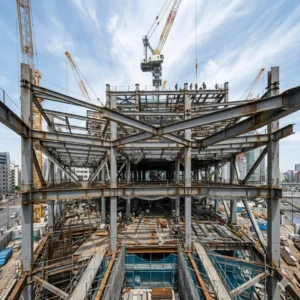
Imagine standing in the middle of the world’s biggest tug-of-war match.
On one side, a team of giant athletes pulls with every ounce of strength they have. On the other side, another team pulls just as hard. The rope stretches tight, vibrating with force and energy, yet somehow it refuses to snap.
That stretching force is what engineers call tension.
Every single day, tension quietly shapes the world around us. When you hang from monkey bars, pull open a heavy gate, or watch a suspension bridge carry thousands of cars across a river, you are seeing tension in action. It is the force that tries to pull materials apart.
Now imagine replacing that tug-of-war rope with something fragile like chalk, concrete, or glass. The moment the force increases, crack — it shatters instantly.
But steel? Steel behaves differently.
Steel can endure enormous pulling forces without breaking. It stretches, adjusts, and fights back against tension in ways most materials simply cannot. That is why steel has become one of the most important materials in human history.
From towering skyscrapers to aircraft, stadiums, bridges, railways, and industrial machinery, steel forms the invisible skeleton of modern civilization.
But what exactly makes steel so strong in tension?
The answer lies in a fascinating combination of atomic structure, chemistry, flexibility, and smart engineering. Once you understand how steel works at the microscopic level, you begin to appreciate why it is considered one of the most reliable and durable building materials ever created.
Let’s dive into the incredible science behind steel’s superpower.
Understanding Tension in Simple Words
Before understanding why steel performs so well, we first need to understand what tension actually means.
In engineering and construction, materials mainly face two types of forces:
Compression
Compression is a squeezing force.
Imagine standing on an empty soda can. The can collapses inward because it cannot resist the pressure pushing down on it.
Materials like stone, brick, and concrete are excellent under compression. That is why ancient castles, pyramids, and concrete pillars can hold massive amounts of weight for centuries.
Tension
Tension is the opposite of compression.
Instead of squeezing, tension pulls materials apart.
Think of stretching a rubber band between your fingers. The more you pull, the more tension you create.
Here is the problem: many materials are terrible at handling tension.
Concrete, for example, is extremely strong when compressed but surprisingly weak when pulled. If you try to stretch concrete from both ends, cracks begin to form almost immediately.
Steel, however, thrives under tension.
Its exceptional tensile strength allows it to resist enormous pulling forces while remaining stable and predictable. This is one of the main reasons steel is used inside reinforced concrete structures, suspension bridges, and earthquake-resistant buildings.
Without steel, many of the world’s most iconic structures simply would not exist.
The Atomic Secret Behind Steel’s Strength
To truly understand steel, we need to shrink ourselves down to the microscopic level.
Steel is mainly made from iron atoms arranged in organized patterns. These atoms are connected through something called metallic bonding.
This is where the magic begins.
Metallic Bonding: The Ultimate Atomic Teamwork
In brittle materials like glass or ceramics, atoms behave rigidly. They lock into fixed positions and resist movement.
When too much tension is applied, these rigid atomic bonds suddenly snap.
Steel behaves differently.
Iron atoms in steel exist inside a shared “sea” of electrons. Instead of clinging tightly to one specific neighbor, the atoms collectively share electrons across the entire structure.
This creates flexibility without losing strength.
When tension pulls on steel, the atoms do not instantly break apart. Instead, they shift slightly, slide carefully, and redistribute stress across the material.
It is almost like millions of tiny teammates working together to keep the structure intact.
This ability to adjust under stress gives steel a huge advantage over brittle materials.
Rather than shattering instantly, steel absorbs and spreads the force.
That is the first major reason steel performs so well under tension.
Carbon: The Tiny Ingredient That Changes Everything
Pure iron is actually softer than most people realize.
If we built bridges entirely from pure iron, the metal would stretch too much under heavy loads. It would slowly deform over time and become unsafe.
This is where carbon enters the story.
Steel is created by mixing iron with small amounts of carbon, usually less than 2%.
Although carbon atoms are tiny, they completely transform the behavior of the metal.
How Carbon Strengthens Steel
Imagine stacking smooth marbles in a box.
The marbles can easily roll and slide around each other.
Now imagine pouring sand into the spaces between the marbles.
Suddenly, movement becomes much harder.
That is exactly what carbon does inside steel.
The small carbon atoms squeeze into the spaces between iron atoms, limiting how freely they can move.
This creates the perfect balance:
- The steel remains flexible enough to absorb tension
- But it also becomes much harder and stronger
Without carbon, steel would be too soft.
With too much carbon, steel becomes brittle.
The ideal balance creates high-strength alloy steel capable of resisting incredible tensile forces while still remaining durable and reliable.
Crystal Structures: Steel’s Internal Defense System
Steel’s strength is not only about chemistry. Its internal structure also plays a major role.
When molten steel cools and solidifies, the atoms organize themselves into geometric patterns called crystal lattices.
These lattices form tiny regions known as grains.
Why Grain Structure Matters
When tension tries to tear steel apart, microscopic cracks begin searching for weak paths through the material.
But the grain boundaries interrupt those cracks repeatedly.
Every boundary forces the crack to change direction and lose energy.
It is similar to trying to sprint through a maze filled with walls.
The crack cannot travel freely, so the force spreads across the structure instead of concentrating in one dangerous location.
This internal grain network is one reason structural steel properties are so valuable in engineering.
It helps steel resist sudden catastrophic failure even under extreme stress.
Ductility: Steel’s Greatest Superpower
One of the most important properties of steel is something called ductility.
Ductility refers to a material’s ability to stretch and deform before breaking.
This characteristic makes steel far safer than brittle materials.
Brittle vs Ductile Materials
Imagine snapping a dry cracker in half.
It breaks instantly with no warning.
That is brittleness.
Now imagine stretching chewing gum.
It deforms slowly before finally tearing.
That is ductility.
Steel behaves much more like chewing gum than glass.
When steel experiences increasing tension, it usually passes through several stages:
1. Elastic Phase
At first, steel stretches slightly and returns to its original shape once the force disappears.
2. Plastic Phase
As the force increases, the steel begins to permanently deform.
Engineers call this yielding or necking.
3. Fracture Phase
Only after enormous stretching does the steel finally break.
This gradual failure process is extremely important in construction and safety engineering.
Instead of collapsing instantly, steel structures often bend and deform first, giving people time to react and evacuate.
This is why steel performs exceptionally well during earthquakes, storms, and heavy structural loads.
Why Steel Dominates Modern Construction
Steel’s incredible tension resistance makes it one of the most trusted construction materials on Earth.
Its combination of strength, flexibility, and durability allows engineers to create structures that were once considered impossible.
Suspension Bridges
Suspension bridges are among the greatest examples of steel working under tension.
The massive cables supporting the bridge deck are constantly being pulled by enormous forces.
Steel cables can handle this stress because of their outstanding tensile strength.
Without steel, long-span bridges like the famous Golden Gate Bridge would not exist.
Skyscrapers
Tall buildings constantly sway due to wind and small ground movements.
Steel frameworks absorb these forces without snapping.
Its ductility allows skyscrapers to flex slightly while remaining stable.
Reinforced Concrete
Concrete alone performs poorly under tension.
That is why engineers insert steel reinforcement bars, known as rebar, inside concrete structures.
The concrete handles compression while steel handles tension.
Together, they form one of the strongest construction systems ever developed.
The Manufacturing Process That Makes Steel Even Stronger
Steel does not naturally emerge perfect from the furnace.
Manufacturers use specialized processes to improve its strength and performance.
Hot Rolling and Forging
During manufacturing, steel is heated to extremely high temperatures and passed through giant rollers.
This process aligns the internal grain structure of the steel.
The aligned grains improve the metal’s ability to resist pulling forces along specific directions.
The result is steel that is stronger, tougher, and more reliable under tension.
Heat Treatment
Many steel products also undergo heat treatments such as quenching and tempering.
These processes carefully control cooling rates to improve hardness, ductility, and toughness.
That is why different types of steel can be customized for specific jobs, including:
- Construction steel
- Automotive steel
- Tool steel
- Stainless steel
- High-strength alloy steel
Each type is engineered to balance strength, flexibility, and durability.
Why Other Materials Cannot Compete
Many materials excel in one area but fail badly in another.
Concrete handles compression brilliantly but struggles under tension.
Glass looks beautiful but breaks suddenly.
Wood is lightweight but can warp, split, or decay.
Steel stands out because it combines multiple strengths together:
- High tensile strength
- Excellent ductility
- Predictable behavior
- Long lifespan
- Recyclability
- Fire resistance
- Structural reliability
That balance is what makes steel one of the world’s most important engineering materials.
Steel and the Future of Engineering
Modern engineers continue improving steel using advanced alloys and manufacturing techniques.
Today’s high-performance steels are lighter, stronger, and more corrosion-resistant than ever before.
Researchers are developing steels capable of surviving:
- Stronger earthquakes
- Higher temperatures
- Heavier industrial loads
- Extreme weather conditions
As cities grow taller and infrastructure becomes more advanced, steel will continue playing a central role in shaping the future.
From futuristic skyscrapers to high-speed rail systems and renewable energy projects, steel remains the backbone of modern civilization.
Final Thoughts
The next time you cross a bridge, step inside a skyscraper, or watch a crane lift massive loads high into the sky, take a moment to appreciate the incredible science hidden inside steel.
Its strength is not accidental.
Steel survives tension because its atoms cooperate beautifully, its carbon content creates balance, and its ductile nature allows it to absorb stress instead of snapping under pressure.
It is a remarkable combination of chemistry, physics, and engineering innovation.
Steel does not merely resist tension — it masters it.
That is why it remains the ultimate tug-of-war champion of the modern world.
References