
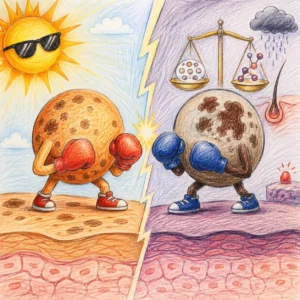
Have you ever stood in front of your bathroom mirror, leaned a little closer, and suddenly noticed a mysterious dark spot staring back at you?
One day your skin looks perfectly fine. The next day, there is a small brown patch on your cheek, forehead, or nose that seems to have appeared out of nowhere. Naturally, your mind starts asking questions.
Is it a sunspot?
Is it pigmentation?
Is it a scar from that giant pimple you had a few months ago?
Or is your skin simply playing tricks on you?
Most people immediately turn to the internet for answers. Unfortunately, that usually leads to an avalanche of confusing terms like melanin production, melanogenesis, solar lentigines, post-inflammatory hyperpigmentation, and ultraviolet radiation.
By the time you finish reading three articles, you feel less informed than when you started.
The good news is that understanding Sun Damage and Pigmentation does not require a medical degree.
In this guide, we’ll break everything down in simple language so you can finally understand what is happening to your skin, why these dark spots appear, and what you can do to restore a brighter, more even complexion.
Let’s settle the great skin debate once and for all.
The Biggest Myth About Sun Damage and Pigmentation
Many people think Sun Damage and Pigmentation are completely different skin concerns.
They are not.
In fact, they are closely related.
Think of pigmentation as a giant umbrella.
Under that umbrella are many different types of skin discoloration, including:
- Sun spots
- Melasma
- Acne marks
- Post-inflammatory hyperpigmentation
- Age spots
- Freckles
Pigmentation simply means that certain areas of your skin become darker than the surrounding skin because of excess melanin production.
Sun Damage is one of the most common causes of pigmentation.
So the relationship is actually very simple:
All sun damage pigmentation is pigmentation, but not all pigmentation is caused by sun damage.
Once you understand this distinction, everything else becomes much easier.
Understanding Pigmentation: Your Skin’s Defense Mechanism
Your skin is smarter than you think.
Deep inside your skin are tiny cells called melanocytes. Their job is to produce melanin, the pigment responsible for your skin, hair, and eye color.
Think of melanocytes as tiny bodyguards.
Whenever your skin experiences stress, irritation, or injury, these bodyguards jump into action.
Their solution?
Produce more melanin.
The extra melanin acts as protection for your skin.
Sometimes this response works perfectly.
Other times, the melanocytes get a little overenthusiastic and create too much pigment in one area.
When that happens, you end up with a dark patch or spot.
That is pigmentation.
Research shows that hyperpigmentation occurs when inflammation, injury, or other triggers stimulate melanocytes to produce excess melanin. Acne, eczema, burns, irritation, and skin trauma are among the most common causes.
Common Types of Pigmentation
1. Post-Inflammatory Hyperpigmentation (PIH)
This is the most common type of pigmentation.
Have you ever had a pimple disappear but leave behind a dark mark?
That mark is usually PIH.
The acne is gone, but the pigment remains.
The skin experienced inflammation, and your melanocytes responded by producing excess melanin during healing.
PIH can also develop after:
- Bug bites
- Cuts and scratches
- Burns
- Eczema
- Skin irritation
The darker mark often fades naturally over time, although it can take months.
2. Melasma
Melasma is a special type of pigmentation that usually appears as larger, symmetrical patches.
It often develops on:
- Forehead
- Cheeks
- Upper lip
- Chin
Hormonal fluctuations are a major trigger.
Pregnancy, birth control pills, and hormonal changes can all contribute to melasma. Sun exposure often makes it worse.
3. Injury-Related Pigmentation
Sometimes even seemingly harmless habits can cause pigmentation.
Examples include:
- Aggressive scrubbing
- Picking at acne
- Waxing irritation
- Friction from clothing
- Minor skin injuries
Your skin attempts to protect itself during healing, leaving behind excess pigment.
Understanding Sun Damage: The Silent Accumulator
Now let’s talk about Sun Damage.
Unlike acne pigmentation, Sun Damage does not usually appear overnight.
It builds slowly.
Very slowly.
Every time ultraviolet (UV) rays hit your skin, your melanocytes receive a warning signal.
They begin producing more melanin as protection.
That protective melanin creates a tan.
Many people view tanning as healthy.
But from a biological perspective, a tan is actually evidence that your skin is defending itself from UV exposure.
Over months and years, repeated sun exposure causes melanocytes to become overactive.
Eventually, pigmentation becomes uneven.
This is when visible Sun Damage starts appearing.
According to Mayo Clinic, sun exposure stimulates melanin production, and over time the pigment may become unevenly distributed, creating dark spots and patchy discoloration.
Signs of Sun Damage
Sun Spots (Solar Lentigines)
These are flat brown spots that typically appear on:
- Face
- Nose
- Forehead
- Hands
- Chest
- Shoulders
They develop after years of cumulative sun exposure.
Persistent Freckles
Natural freckles often fade when sun exposure decreases.
Sun-damage freckles tend to become darker and more permanent over time.
Uneven Skin Tone
Sun Damage often causes blotchy areas of pigmentation that make skin appear uneven.
Fine Lines and Wrinkles
UV rays do more than create pigmentation.
They also break down collagen and elastin, contributing to premature aging and wrinkles.
Rough Texture
Long-term UV exposure can make skin feel rough, leathery, and less smooth than before.
Sun Damage vs Pigmentation: How to Tell the Difference
When looking in the mirror, use these clues.
General Pigmentation
Appearance:
- Larger patches
- Acne marks
- Discoloration after irritation
Location:
- Anywhere on the face or body
Trigger:
- Acne
- Hormones
- Injury
- Skin inflammation
Behavior:
- Usually stays relatively stable
Sun Damage Pigmentation
Appearance:
- Small brown spots
- Freckles
- Uneven patches
Location:
- Areas exposed to sunlight
Trigger:
- Years of UV exposure
Behavior:
- Often darkens after sun exposure
A simple rule:
If the mark appeared after a pimple, injury, or irritation, it is likely pigmentation.
If it appears on frequently sun-exposed areas and gradually increased over the years, Sun Damage is often the culprit.
Why Some People Get More Pigmentation Than Others
Several factors influence how likely you are to develop pigmentation.
Skin Tone
People with medium to deeper skin tones naturally have more active melanocytes and may develop pigmentation more easily following inflammation.
Genetics
Some people are genetically predisposed to freckles, melasma, or uneven pigmentation.
Hormones
Hormonal fluctuations can dramatically increase pigment production.
Sun Exposure
Even brief daily exposure adds up over time.
Skin Trauma
Picking, scratching, or over-exfoliating can trigger new pigmentation.
The Best Strategy for Treating Both Conditions
The good news?
Most treatment principles overlap.
Whether your dark spots come from Sun Damage or Pigmentation, the goal is the same:
- Prevent new spots.
- Stop excess melanin production.
- Fade existing pigment.
Let’s look at each step.
Step 1: Wear Sunscreen Every Day
This is the single most important step.
Without sunscreen, every other treatment becomes significantly less effective.
UV exposure continuously activates melanocytes and worsens pigmentation.
Dermatologists consistently recommend daily broad-spectrum SPF protection as the foundation of treatment for hyperpigmentation and melasma.
Choose:
- SPF 30 or higher
- Broad-spectrum protection
- Daily application
Yes, even on cloudy days.
Yes, even indoors near windows.
Step 2: Add Brightening Ingredients
Several ingredients have strong evidence supporting their ability to improve pigmentation.
Vitamin C
Vitamin C helps protect skin from oxidative stress while promoting a brighter appearance.
Benefits include:
- Improved radiance
- Antioxidant protection
- Reduced appearance of dark spots
Niacinamide
Niacinamide helps regulate pigment transfer and supports a healthier skin barrier.
Benefits include:
- Reduced discoloration
- Less redness
- Improved skin texture
Alpha Arbutin
Alpha Arbutin helps reduce excess melanin production and gradually fades dark spots.
Kojic Acid
Kojic Acid is a popular brightening ingredient frequently used to improve uneven skin tone.
Azelaic Acid
Especially useful for acne-related pigmentation and melasma.
Step 3: Exfoliate Gently
Many people attack pigmentation with aggressive scrubs.
Unfortunately, harsh scrubbing often creates even more pigmentation.
Instead, choose gentle exfoliants like:
- Glycolic Acid
- Lactic Acid
- Mandelic Acid
These ingredients help remove pigmented surface cells without excessive irritation.
The key word is gentle.
More exfoliation does not equal faster results.
Step 4: Be Patient
This may be the hardest step.
Pigmentation rarely disappears overnight.
Most dark spots improve gradually over weeks and months.
Research shows that some forms of post-inflammatory hyperpigmentation may take several months to fade, while deeper pigmentation can persist much longer.
Consistency beats intensity.
A simple routine followed every day will outperform an expensive routine used inconsistently.
When Should You See a Dermatologist?
Consider professional help if:
- Pigmentation is spreading rapidly
- Spots change shape or color suddenly
- Over-the-counter products are not helping
- Melasma continues worsening
- You are unsure what type of pigmentation you have
A dermatologist can recommend prescription treatments, chemical peels, laser procedures, or other targeted solutions when appropriate.
Final Thoughts
The debate between Sun Damage and Pigmentation is not really a battle at all.
Pigmentation is the broader category.
Sun Damage is simply one of its most common causes.
Understanding that difference removes much of the confusion surrounding dark spots.
Whether your discoloration comes from old acne, hormonal fluctuations, skin irritation, or years of sunshine, the path forward remains remarkably similar:
- Protect your skin daily with sunscreen.
- Use proven brightening ingredients.
- Exfoliate gently.
- Stay consistent.
Your skin is constantly renewing itself. With patience, proper care, and realistic expectations, even stubborn discoloration can gradually fade.
The next time you spot a mysterious dark mark in the mirror, you will know exactly what questions to ask—and more importantly, what steps to take next.
Your brighter, more even-toned skin journey starts today.
References
Post-Inflammatory Hyperpigmentation (NCBI)
Sun Damage Explained (Mayo Clinic)