

There is a peculiar moment when your body starts making noises you are pretty sure it wasn’t making ten years ago.
You get out of bed and your knee says, crrrrk.
You bend down to pick something up and your lower back responds with, Absolutely not.
You climb a flight of stairs and suddenly your joints sound like someone is slowly opening an ancient wooden treasure chest.
At first, you laugh it off. Then you start changing the way you move. You avoid stairs. You stop sitting on the floor. You hesitate before getting out of a chair. Eventually, persistent pain or stiffness may send you to a doctor, physical therapist, or orthopedic specialist.
And sometimes, medical treatment—including surgery—is exactly what you need.
But here’s the important part: not every ache, stiff joint, or chronic movement problem automatically means your body is heading toward an operating room.
For many people, especially those dealing with conditions such as osteoarthritis or chronic musculoskeletal pain, conservative approaches such as exercise, physical therapy, strength training, and other movement-based strategies can play an important role.
One surprisingly gentle option is Tai Chi.
It doesn’t involve jumping onto a treadmill while someone screams motivational quotes at you. There are no giant weights to lift and no complicated gym machines waiting to judge your coordination.
Instead, Tai Chi uses slow, controlled movements, shifting body weight, balance, breathing, and concentration.
And while it certainly isn’t a magical replacement for medical treatment, research suggests it may help people manage pain, stiffness, mobility, and physical function—particularly in conditions such as osteoarthritis. A 2025 systematic review of 28 studies involving 1,676 people with osteoarthritis found that Tai Chi improved pain, mobility, physical function, and stiffness compared with non-exercise controls.
So, before we declare war on every creaky knee in the neighborhood, let’s take a closer look.
When Pain Makes You Think, “Something Must Be Broken”
Pain has a way of making us imagine the worst.
A sore knee becomes damaged cartilage.
A stiff back becomes serious spinal problems.
A painful shoulder becomes I probably need surgery.
Sometimes those concerns are justified. But pain and structural changes don’t always tell the same story.
For example, osteoarthritis can involve changes to cartilage, bone, muscles, and surrounding tissues. Yet the amount of visible wear on an X-ray doesn’t necessarily predict exactly how much pain someone will experience.
That’s one reason treatment shouldn’t be based on an image alone.
A doctor may consider your symptoms, physical examination, medical history, activity level, strength, mobility, and imaging before deciding what treatment makes sense.
And when conservative treatment is appropriate, movement can be a powerful part of the plan.
The American College of Rheumatology and Arthritis Foundation’s osteoarthritis guideline strongly recommends exercise for people with osteoarthritis and specifically gives a strong recommendation for Tai Chi for knee and hip osteoarthritis.
That’s quite different from saying, “Throw away your doctor’s phone number and do Tai Chi instead.”
The goal is not to choose ancient movement instead of modern medicine.
The goal is to understand that modern medicine includes more than surgery.
Sometimes the smartest treatment is the least dramatic one.
So, What Exactly Is Tai Chi?
Tai Chi is a traditional Chinese mind-body practice involving slow, deliberate movements, weight shifting, balance, breathing, and focused attention.
You’ve probably seen it before.
A group of people stands outside in a park, moving so slowly that you briefly wonder whether someone pressed the pause button on reality.
But underneath those gentle movements is a surprisingly sophisticated form of physical activity.
Tai Chi asks you to:
- Shift your weight carefully.
- Control your posture.
- Coordinate your arms and legs.
- Move through comfortable ranges of motion.
- Pay attention to where your body is in space.
- Maintain balance.
- Breathe steadily.
- Stay mentally focused.
That combination makes it particularly interesting for people who want a low-impact activity.
And because the movements can be modified, Tai Chi can often be adapted to different fitness levels.
You don’t have to perform a dramatic martial-arts routine while standing on one leg in the middle of your living room.
In fact, please don’t do that if your balance isn’t ready for it.
Your living room does not need an orthopedic emergency.
Why Tai Chi May Help Aching Joints
1. It Gets You Moving Without Beating Up Your Joints
When something hurts, the natural reaction is often to stop moving.
It makes sense.
Your brain says, Movement hurts, therefore movement is dangerous.
Unfortunately, avoiding movement completely can contribute to weakness, stiffness, reduced confidence, and loss of physical function.
Gentle exercise can provide a different message:
Movement can be safe when it is appropriately chosen and gradually progressed.
Tai Chi’s slow movements allow you to practice controlled weight shifting and joint movement without the pounding associated with high-impact activities.
That doesn’t mean every movement is appropriate for every person. Pain should be respected, and exercises may need to be modified.
But gentle movement can be a useful way to keep your body participating rather than permanently parked on the sofa.
2. It Can Improve Balance
Balance becomes increasingly important as we age.
You don’t necessarily notice balance when it’s working well. You simply walk across the room, step off a curb, turn around, and carry on with your day.
But when balance becomes less reliable, ordinary situations can suddenly feel like obstacle courses.
Tai Chi repeatedly challenges your ability to shift weight, control your center of gravity, coordinate movement, and remain stable.
Research in people with knee osteoarthritis has found improvements in measures of dynamic balance alongside improvements in pain, stiffness, and physical function.
Think of it as giving your brain and body more opportunities to practice working together.
3. It Encourages Better Body Awareness
Have you ever watched someone walk while staring at their phone and thought, This person is one notification away from walking directly into a lamppost?
Modern life can make us surprisingly disconnected from our own movement.
We sit for hours.
We stare at screens.
We drive.
We stand up suddenly.
We rush.
Tai Chi slows everything down.
You become more aware of where your feet are, where your weight is going, whether your shoulders are tense, and how your body moves from one position to another.
That awareness can be valuable because good movement isn’t just about strength.
It’s also about coordination and control.
4. It May Help With Chronic Musculoskeletal Pain
Tai Chi has also been studied beyond osteoarthritis.
An updated systematic review and meta-analysis found moderate-quality evidence that Tai Chi could improve pain and disability in people with chronic musculoskeletal pain compared with no treatment or usual care, although the evidence and effects varied across conditions.
More recent research has also investigated Tai Chi for chronic low back pain. A 2026 systematic review of randomized controlled trials reported potential improvements in pain and physical function, while emphasizing that the evidence was not equally strong for every outcome.
In other words, Tai Chi looks promising—but promising is not the same thing as miraculous.
That’s an important distinction.
Five Beginner-Friendly Tai Chi Movements
You don’t need to memorize an entire Tai Chi sequence before you begin.
A qualified instructor can teach you a complete routine, but several familiar movements can help you understand the basic principles.
1. Parting the Wild Horse’s Mane
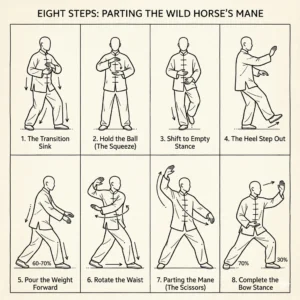 Imagine you’re gently holding a large beach ball in front of your chest.
Keep your knees soft and your posture relaxed.
As you slowly shift your weight and step forward, allow your hands to separate smoothly—one moving upward and outward while the other moves downward.
Then reverse the movement.
The key isn’t speed.
The key is coordination.
Imagine you’re moving through water rather than trying to win a race against an invisible opponent.
2. Wave Hands Like Clouds
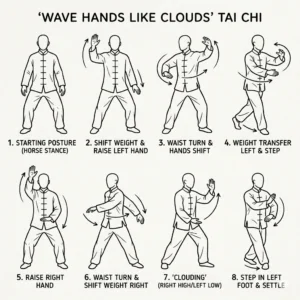 This movement involves gently shifting your weight from side to side while your hands move in smooth, flowing patterns.
Keep your knees relaxed.
Allow your torso to rotate comfortably rather than forcing the movement.
Your eyes can follow the upper hand.
The goal is to create a continuous rhythm between your feet, hips, torso, arms, and breathing.
If you look slightly ridiculous at first, congratulations.
You’re doing it correctly.
Nobody looks like a Tai Chi master on day one.
3. Repulse the Monkey
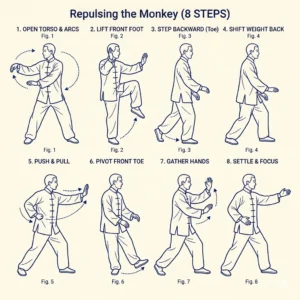 This movement combines gentle stepping, arm movements, weight shifting, and torso rotation.
Rather than forcing your spine to twist, allow the movement to develop naturally from your hips and torso.
Keep your shoulders relaxed.
The name may sound like you’re preparing for a backyard primate emergency, but the exercise is really about controlled coordination and smooth movement.
4. Brush Knee and Push
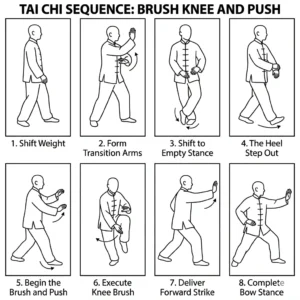 This movement combines stepping with coordinated arm movements.
Start slowly.
Practice shifting your weight first. Then add the arms.
This is a useful Tai Chi lesson in general: don’t try to make your entire body perform choreography at once.
Break the movement into pieces.
Master the pieces.
Then put them together.
Your brain will thank you.
5. The Golden Rooster Stands on One Leg
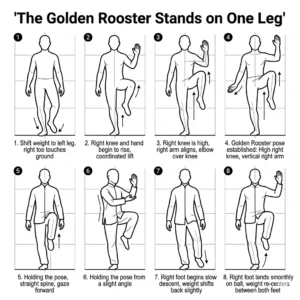 Balance practice can be useful, but safety comes first.
Stand beside a sturdy counter, railing, or other stable support.
Shift your weight onto one leg.
Instead of immediately trying to lift the other knee dramatically toward the ceiling, begin by simply unloading the opposite foot.
You might lift the heel.
Then the toes.
Eventually, if appropriate, you can briefly lift the foot.
Hold for only as long as you can remain stable.
This isn’t an audition for a flamingo impersonation contest.
The goal is controlled balance—not heroic wobbling.
The Most Important Rule: Don’t Chase Pain
There’s a dangerous misconception that exercise only works if it hurts.
Please don’t bring that philosophy into Tai Chi.
Tai Chi should generally feel controlled and comfortable, although starting a new activity can sometimes produce mild muscle soreness.
Sharp, severe, escalating, or unusual pain is different.
If a movement causes significant pain, stop and discuss the problem with a qualified healthcare professional.
You should also seek medical attention for symptoms such as sudden severe pain, major swelling, significant weakness, numbness, loss of bladder or bowel control, a serious injury, or other symptoms that concern you.
And if you’ve been told you need surgery, don’t cancel it because you watched three Tai Chi videos before breakfast.
Talk with your doctor.
Tai Chi can be a complementary strategy, but it isn’t a universal substitute for necessary medical care.
Tai Chi vs. Surgery: It’s Not Really a Competition
This is where the original “surgery versus Tai Chi” idea needs a little reality check.
Surgery and Tai Chi aren’t two competing teams waiting for a championship match.
They serve very different purposes.
Surgery can be essential for certain injuries, advanced conditions, structural problems, or situations where conservative care isn’t enough.
Tai Chi is a form of exercise and mind-body practice that may support mobility, balance, physical function, and symptom management.
Sometimes someone may benefit from Tai Chi before surgery.
Sometimes after surgery.
Sometimes alongside physical therapy.
And sometimes it may simply be part of a long-term strategy for staying active.
The smartest approach is usually not:
“How do I avoid surgery at all costs?”
It’s:
“What treatment gives me the best chance of staying functional, safe, and active?”
That’s a much better question.
How to Start Without Turning Your Living Room Into a Martial Arts Academy
Start small.
Try five to ten minutes.
Choose comfortable clothing.
Wear stable footwear or follow your instructor’s guidance about footwear.
Keep a sturdy support nearby if balance is an issue.
Don’t worry about looking elegant.
You probably won’t.
That’s okay.
Focus on slow weight shifts, relaxed shoulders, comfortable breathing, and controlled movements.
As you become more comfortable, gradually increase your practice.
A qualified Tai Chi instructor—especially one experienced in working with older adults or people with joint problems—can be extremely helpful.
If you have a medical condition, recent injury, significant pain, or major balance problems, ask your healthcare professional whether Tai Chi is appropriate and whether any movements should be modified.
What the Research Really Tells Us
The evidence for Tai Chi is encouraging, especially for osteoarthritis.
A 2025 meta-analysis found improvements in pain, mobility, physical function, and stiffness among people with osteoarthritis. Importantly, Tai Chi produced broadly similar effects to other forms of exercise for several outcomes, which tells us something useful: Tai Chi doesn’t necessarily work because it is magical; it may work because it is a practical form of regular physical activity that people can perform consistently.
That is actually good news.
You don’t need magic.
You need something you can safely do and realistically continue.
Research on knee osteoarthritis has also found clinically meaningful improvements in pain, stiffness, and physical function.
And clinical guidelines support exercise as an important part of osteoarthritis management, with Tai Chi specifically recommended for knee and hip osteoarthritis.
So perhaps the biggest lesson isn’t that Tai Chi can “save you from surgery.”
It’s that movement deserves a seat at the treatment table.
Your Body Doesn’t Need a Miracle. It Needs a Plan.
When your knee aches, your back stiffens, or your body starts feeling less cooperative than it used to, panic isn’t particularly helpful.
Neither is pretending nothing is wrong.
The sweet spot is somewhere in between.
Get the problem evaluated.
Understand what’s happening.
Follow appropriate medical advice.
And when movement is safe for you, keep moving.
Tai Chi offers one gentle way to do that.
It can help you practice balance, coordination, mobility, and body awareness without turning exercise into an aggressive battle between you and your joints.
You don’t need to become a martial arts expert.
You don’t need a fancy uniform.
You don’t need to perform 108 movements before breakfast.
Start with a few slow movements.
Breathe.
Shift your weight.
Relax your shoulders.
Pay attention to your body.
And remember: the goal isn’t to become invincible.
It’s to remain capable.
Because growing older doesn’t have to mean becoming afraid of movement.
Your body may creak.
Your knees may complain.
Your back may occasionally submit a strongly worded memo.
But with appropriate medical care, regular movement, and a little patience, you can keep giving your body reasons to stay strong, mobile, and involved in the life you’re actually trying to live.
And sometimes, the gentlest step forward is still a very powerful one.
References
Osteoarthritis Clinical Practice Guidelines by ACR
Recent systematic review on chronic low back pain and Tai Chi.