
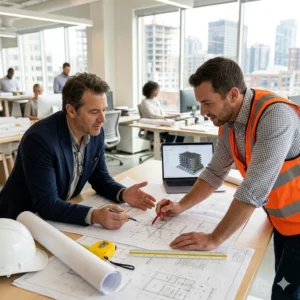
When people admire a breathtaking skyscraper, a cozy modern home, or a stunning bridge stretching across the horizon, they usually praise the architect. Others admire the engineering brilliance behind the structure. But the real magic rarely belongs to one profession alone.
Every unforgettable building is the result of a powerful team.
Behind every elegant curve, towering frame, and perfectly balanced structure stands a partnership that quietly shapes the world around us: the collaboration between architects and structural engineers.
For years, these two professions have been jokingly portrayed as rivals. Architects are often seen as dreamers who want beauty without limits, while structural engineers are labeled as cautious realists obsessed with calculations and safety rules.
But the truth is far more inspiring.
Neither profession can truly succeed without the other.
When architects and structural engineers work together as one united team, they create buildings that are not only visually stunning but also safe, functional, efficient, and built to last for generations.
This partnership is not simply about construction. It is about balancing imagination with logic, creativity with precision, and vision with stability.
And honestly? That balance is exactly what makes great architecture possible.
The Dreamer and the Problem Solver


To understand why this collaboration matters so much, you first need to understand how differently these professionals think.
An architect sees possibility.
They imagine how sunlight will pour through large windows in the morning. They think about emotions, comfort, beauty, movement, and human experience. Architects are storytellers who use buildings as their language.
They ask questions like:
- How will people feel inside this space?
- Can this building become an iconic landmark?
- How do we combine beauty with purpose?
- How can the design improve everyday life?
Structural engineers view the same project from another angle entirely.
They think about gravity, pressure, earthquakes, storms, and material strength. They calculate how every beam, column, and foundation must work together to support the entire structure safely.
Their questions sound very different:
- Can this roof safely carry its load?
- How will the building react during strong winds?
- What happens if the ground shifts?
- Will the materials survive decades of stress?
At first glance, these viewpoints seem completely opposite.
But together, they create balance.
An architect without an engineer may design something visually extraordinary but structurally impossible. An engineer without an architect may create a building that is durable but lifeless and uninspiring.
The real magic happens when imagination and practicality sit at the same table.
That is where innovation begins.
Why Team Collaboration Saves Massive Costs


Construction mistakes are incredibly expensive.
A single design error discovered during construction can delay a project for weeks or even months. In large commercial developments, those delays can cost millions.
Imagine an architect designs a beautiful open-concept hall with sweeping curved ceilings and minimal support columns. The concept looks incredible on paper.
Then the structural engineer reviews the design and discovers the roof cannot safely support itself without additional steel supports directly in the middle of the room.
Suddenly:
- The design must change.
- Deadlines are pushed back.
- Materials must be reordered.
- Contractors lose time.
- Budgets explode.
Now imagine a different scenario.
Instead of working separately, the architect and engineer collaborate from the very beginning.
While the architect sketches the curved roof, the engineer immediately suggests lightweight framing systems or alternative structural solutions that preserve the original vision without compromising safety.
Problems are solved early — before construction begins.
That is the power of a strong team.
Early collaboration reduces:
- Design conflicts
- Material waste
- Delays
- Miscommunication
- Unexpected construction costs
In today’s construction industry, teamwork is no longer optional. It is essential.
The Buildings That Changed the World


Some of the most famous structures in history exist because architects and engineers trusted each other enough to push boundaries together.
Take the Burj Khalifa, for example.
The world’s tallest building required architects, engineers, material scientists, and construction experts to work as one synchronized team. Without extraordinary collaboration, the tower simply could not exist.
The same is true for the Sydney Opera House.
Its iconic sail-shaped roof was considered nearly impossible to engineer when the project began. Yet through years of innovation and teamwork, engineers developed entirely new structural methods to turn the architect’s vision into reality.
Even the legendary Eiffel Tower was once viewed as a risky engineering experiment.
These structures remind us of something important:
Great achievements happen when creative minds and technical minds stop competing and start collaborating.
Innovation is born from partnership.
Communication Is the Hidden Superpower
Many construction failures do not happen because people lack talent.
They happen because teams fail to communicate.
Traditional workflows often create unnecessary separation between designers, engineers, contractors, and clients. Information passes from one department to another like a game of broken telephone.
By the time updates reach the construction site, confusion and frustration have already taken over.
But modern construction teams are changing this.
Today, architects and engineers increasingly work together using shared digital tools such as:
- Building Information Modeling (BIM)
- Real-time 3D collaboration software
- Structural simulation platforms
- Cloud-based project management systems
These technologies allow teams to identify problems before construction even begins.
Instead of endless email chains and misunderstandings, professionals can collaborate instantly.
A pipe conflict? Solve it immediately.
A beam adjustment? Review it together in real time.
A safety concern? Address it before it becomes dangerous.
Strong communication creates smoother projects, happier clients, safer buildings, and far fewer costly surprises.
Safety Is the Real Legacy
At its core, construction is not really about concrete, glass, or steel.
It is about people.
Buildings become part of human life.
They protect families during storms. They provide spaces for businesses, schools, hospitals, and communities. They hold memories, dreams, celebrations, and entire generations of stories.
That responsibility is enormous.
When architects and engineers fail to collaborate properly, small mistakes can become major safety risks.
Poor coordination can lead to:
- Weak structural connections
- Water damage issues
- Unsafe load distribution
- Fire safety concerns
- Expensive long-term repairs
But when both professions operate as one unified team, every detail receives multiple layers of attention.
Architects focus on usability, comfort, and human experience.
Engineers focus on durability, resilience, and protection.
Together, they create buildings that are not only beautiful but trustworthy.
And that trust is what truly defines great construction.
The Life Lesson Hidden Inside Construction
There is actually a deeper lesson inside this professional relationship.
Every successful life needs both the architect and the engineer mindset.
Sometimes you must be the architect.
You need imagination, creativity, ambition, and vision. You need to dream bigger than your current reality.
But you also need the structural engineer within you.
You need discipline, resilience, planning, and a strong foundation capable of surviving life’s storms.
Dreams without structure collapse.
Structure without dreams feels empty.
Balance creates greatness.
The same principle that builds extraordinary buildings can also build a meaningful life.
The Future Belongs to Collaborative Teams
The construction industry is evolving rapidly.
Modern buildings are becoming more sustainable, more technologically advanced, and more architecturally ambitious than ever before. These challenges cannot be solved by isolated professionals working alone.
The future belongs to connected, collaborative teams.
Architects, structural engineers, contractors, sustainability experts, and digital designers must work together from the earliest stages of every project.
Because the world no longer needs isolated brilliance.
It needs unified brilliance.
The next time you walk into a stunning building, pause for a moment.
Behind those walls is more than concrete and steel.
You are standing inside the result of trust, communication, creativity, mathematics, innovation, and teamwork.
You are standing inside a masterpiece built by a team.
Final Thoughts
The playful rivalry between architects and structural engineers may never disappear completely — and honestly, that friendly tension often sparks creativity.
But the era of the lone genius is fading.
Today’s greatest structures are built through collaboration, mutual respect, and shared problem-solving.
Architects bring the vision.
Structural engineers bring the strength.
Together, they create buildings that inspire people while protecting them.
And that partnership may just be one of the most important teams in the modern world.
References
SAP2000 Official Software Page