
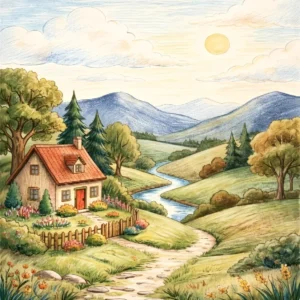
Mastering the art of realistic drawing requires more than just picking up a pencil and sketching what you see. It demands a systematic approach to building value, texture, and dimension. For many art enthusiasts building an online art portfolio, creating a believable realistic landscape using colored mediums remains one of the most frustrating challenges. Many beginners find their colors looking muddy, flat, or scratched.
If you want to transform your casual sketching tips into professional-grade drawing techniques, this ultimate art tutorial will break down the exact process. By understanding how to manipulate your tools, you can turn a simple landscape sketch into a breathtaking, vibrant piece of handmade artwork. Let us dive deep into the ultimate colored pencil tutorial designed specifically to elevate your pencil art and unlock limitless drawing ideas for your next project.
Section 1: The Foundations of Realistic Landscape Drawing
Before applying a single stroke of vibrant pigment to your paper, you must understand the rules of composition and perspective. A scenic drawing succeeds or fails based on its structural layout. When developing a nature drawing, your primary goal is to translate a three-dimensional world onto a flat, two-dimensional sheet of paper.
Understanding Atmospheric Perspective
In a realistic landscape, objects that are closer to the viewer appear larger, sharper, darker, and more saturated. Conversely, objects in the distance look smaller, softer, lighter, and cooler. This phenomenon is known as atmospheric perspective.
- The Foreground: This area contains your highest contrast, sharpest details, and darkest values.
- The Midground: This serves as the transitional space where your main subjects often sit.
- The Background: This consists of distant horizons, clouds, and faraway hills that dissolve into soft hues.
By mapping out these zones during the initial phase of your landscape drawing, you establish a clear visual hierarchy. This structural phase is a core principle taught in every advanced drawing tutorial, guiding the viewer’s eye smoothly through your visual narrative.
Choosing Your Reference and Materials
To build a stunning piece of colored pencil art, your choice of paper and tools is critical. Cheap, smooth printer paper cannot handle multiple layers of wax or oil-based pigments. Instead, opt for a heavy, acid-free medium with a slight texture or “tooth.” The tooth refers to the microscopic valleys in the paper fibers that hold onto the pencil particles.
When brainstorming drawing ideas, always select a reference image or a real-world view that features a strong light source. Clear highlights and distinct shadows provide the framework necessary to apply advanced realistic shading later in the process.
Section 2: Step-by-Step Structural Drafting
+--------------------------------------------------------+

|                                  \  |  /  (Sun)         |
|      /\          /\               --O--                |
|     /  \  /\    /  \        /\   /  |  \               |
|    /    \/  \  /    \______/  \                        |
|___/__________\/________________\_______________________| <--- Horizon Line
|                 |    \__                               |      (Upper 1/3)
|                 |       \___                           |
|                 |           \____                      |
|  [Cottage]     /                 \____  (Winding River)|
|               /                       \___             |
|                                           \            |
+--------------------------------------------------------+
Step 1: Establish Your Depth and Horizon Lines
Every great landscape sketch starts with a proper foundation. Before touching your colored utensils, lightly sketch your layout using a standard graphite tool. Keep your lines incredibly faint so they do not bleed into your final color layers.
- Position the Horizon: Place your horizon line across the upper third of your page. Avoid placing it dead center, as a symmetrical split cuts your composition awkwardly in half.
- Draft the Background Elements: Sketch distant mountains using soft, overlapping curves. Ensure these lines are fluid and natural; nature rarely features harsh, perfectly straight angles.
- Anchor the Focal Point: Draw your main subject, such as a cozy cottage, rustic fence, or a large tree, in the foreground or lower midground third. This gives the viewer an immediate anchor point to look at.
- Incorporate Leading Lines: Add a winding river, a dusty path, or a shoreline that shrinks dynamically as it travels toward the distant mountains. This instantly creates a convincing 3D perspective, transforming a flat pencil sketch into an immersive experience.
Section 3: Mastering Colored Pencil Techniques
Once your structural layout is locked in, it is time to transition into the core of colored pencil drawing. Unlike paints, which can be mixed on a palette, colored pencils must be blended directly on the paper surface. This requires patience, control, and a deep understanding of specialized shading techniques.
| Technique Name | Pencil Pressure | Best Used For | Visual Effect |
|---|---|---|---|
| Circulism | Light to Medium | Skies, skin tones, smooth walls | Seamless, textureless blending |
| Hatching | Light | Grass, wood grain, foliage texture | Linear, organic patterns |
| Cross-Hatching | Medium | Deep shadows, rocks, crevices | Heavy, dark intersecting values |
| Burnishing | Heavy (Final Layer) | Water reflections, polished surfaces | Glassy, high-saturation shine |
The Power of Pencil Pressure Control
The number one mistake made in beginner drawing is pressing down too hard during the initial layers. Heavy pressure crushes the delicate texture of your paper. Once the paper tooth is completely flattened, it becomes physically impossible to add more color layers on top. Your pencils will simply glide across the slick surface without leaving any pigment behind.
To avoid this, maintain a relaxed grip far back on the pencil shaft. This automatically reduces the downward force of your hand, allowing you to lay down delicate, transparent veils of color that can be easily modified, blended, and built upon.
Section 4: Step-by-Step Color Layering and Blending
Step 2: Master the Art of Color Layering
The true secret to radiant colored pencil art lies in slow, methodical value building. Think of your colors as transparent sheets of colored glass stacked on top of each other. The light passes through every single layer, bounces off the white paper underneath, and reflects back into the viewer’s eye.
       [ Light Source ]
            │   ▲
            ▼   │  (Reflected Light)
   ┌─────────────────┐ ◄── Layer 3: Dark Highlights
   ├─────────────────┤ ◄── Layer 2: Mid-tones
   ├─────────────────┤ ◄── Layer 1: Light Base Coat
   └─────────────────┘ ◄── Textured Art Paper Tooth
- The Base Coat: Start by applying a very light, circular layer of your lightest local values. Use a pale yellow or cream for the sky, a soft chartreuse or pale green for the fields, and a muted lavender or soft blue for the distant mountains.
- Building the Mid-tones: Slowly build up darker shades over your base coat. Introduce rich olive greens to the grass fields, warm ochres to the soil, and mid-tone teals to the flowing water. Use small, overlapping circular motions to avoid visible line gaps.
- Injecting Rich Contrast: Introduce deep blues, dark purples, and deep indigos into the deepest shadows of your mountains, under tree canopies, and behind the cottage roof. Avoid using pure black pencils early on; black can muddy your colors and flatten your landscape. Instead, mixing complementary colors creates a richer, more realistic shadow tone.
Section 5: Perfecting Shadows, Light, and Form
Step 3: Align Your Shading with the Light Source
To give your scenic drawing true life, three-dimensional form, and a believable sense of atmosphere, you must establish a single, fixed light source. In this specific landscape art piece, the sun sits high in the sky, casting brilliant light downward and slightly forward onto our scene.
- Consistent Shadow Fall: Ensure every shadow falls consistently away from your light source. If the sun is in the upper right, shadows must stretch toward the lower left.
- Protect Your Highlights: Keep the tops of your trees, the roof of the cottage, and the crests of the rolling hills exceptionally bright. Leave the white of the paper showing through if necessary to create a luminous effect.
- Smoothing Out the Grain: Use a white colored pencil or a dedicated colorless blender tool to smoothly merge your light and dark areas together. Apply firm, even pressure during this final phase to crush the remaining paper grain, locking in a smooth texture without smudging away your fine details.
Section 6: Expanding Your Technical Skill Set
The Nuances of Pencil Shading and Texture
Every object in nature possesses a unique texture that requires a specific movement of your hand. A rock should look rough and rigid, while water should appear fluid and reflective.
- Foliage and Trees: Do not try to draw every single leaf. Instead, look at trees as clusters of geometric shapes. Shade the shadow side of each cluster using circular scribbles, and highlight the edges facing the sun. This technique creates a organic illusion of depth.
- Water and Reflections: Water acts like a mirror, reflecting the sky and surrounding land. Use horizontal strokes to render water surfaces. Keep your lines perfectly straight to communicate a calm, flat liquid plain.
- Clouds and Atmosphere: Use your hand’s lightest touch to form clouds. Blend the bottom edges of clouds softly into the sky while keeping the top edges crisp and white to indicate puffy volume.
By constantly varying your shading techniques, you ensure that your handmade drawing looks dynamic, textured, and deeply engaging to anyone browsing your digital art portfolio.
Section 7: Overcoming Common Mistakes in Colored Pencil Art
Even with a detailed drawing tutorial, beginners frequently hit roadblocks that can derail their progress. Recognizing these pitfalls early will save you hours of frustration and dramatically improve your realistic landscape results.
Avoiding the Trap of “Flat Colors”
A common error in beginner drawing is using only one pencil color for a specific object. For example, coloring an entire field with just one shade of green results in a flat, cartoonish look. In reality, a natural field contains yellow, brown, blue, gray, and even red tones. Always mix multiple pencils together to capture the true, organic complexity of nature.
Managing Paper Saturation
If your pencil starts slipping or picking up previous layers instead of depositing new color, your paper is saturated. This happens when you apply heavy pressure too quickly, filling up the paper’s tooth with wax before your colors are fully blended. To fix this, always build values in thin gradients. If saturation happens, press a piece of low-tack artist tape over the area to gently pull away excess wax buildup.
Section 8: Final Finishing Touches and Portfolio Curation
The final 5% of your drawing time determines the ultimate quality of your landscape art. This is the stage where you step back from your desk, analyze your work as a whole, and make micro-adjustments to maximize the dramatic impact of your composition.
       [ Final Evaluation Matrix ]
                    │
       ┌────────────┴────────────┐
       ▼                         ▼
[Contrast Check]          [Detail Clean-up]
• Darken deep shadows     • Sharpen crisp edges
• Clean white highlights  • Erase stray marks
- Enhance Your Values: Take a deep indigo or dark sepia pencil and darken the absolute deepest nooks of your drawing—such as the undersides of rocks or crevices in tree trunks. This subtle contrast pop instantly brings the background forward.
- Crisp Up Edges: Use a sharply pointed pencil to clean up focal points, like the clean edges of the cottage window frames or the sharp contour lines of the closest mountain ridge.
- Clean Stray Marks: Use a clean kneaded eraser to lift away any accidental pigment flakes from your borders. A clean presentation is vital when showcasing your realistic art to an audience.
➔ Want to See More Lifestyle and Nature Art?
If you love this creative lifestyle path and want plenty of fresh drawing ideas for your next sketching project, you can explore my full personal collection of finished sketches, landscapes, and unique animations!
References