
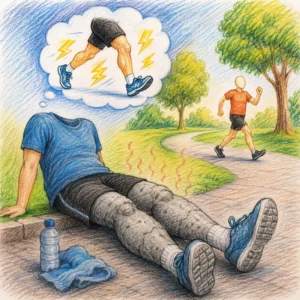
There is a very specific kind of disappointment that hits when you decide to become healthier.
You wake up motivated. You put on your favorite workout clothes, lace up your sneakers, queue an energetic playlist, and step outside feeling like the main character in a fitness transformation video.
Today is the day.
Today you reclaim your health.
Then reality arrives.
You walk for five minutes.
Suddenly, your legs feel as if someone secretly replaced your muscles with bags of wet sand. Your calves tighten. Your thighs burn. Your breathing becomes dramatic enough to deserve its own documentary soundtrack.
Meanwhile, an elderly neighbor casually power-walks past you while carrying grocery bags and talking on the phone without even breathing hard.
At that moment, your confidence collapses faster than a cheap lawn chair.
If this sounds familiar, you are not lazy, weak, or broken. Your body is simply reacting to habits, movement patterns, and energy systems that have slowly adapted to modern life.
The good news?
Your stamina can absolutely improve.
The heavy-leg feeling, the quick exhaustion, and the “I need to sit down immediately” sensation are all fixable with surprisingly small changes.
Let’s break down the real reasons your legs give up so fast — and how to bring your energy back to life.
Your Body Adapts to the Life You Live
Human bodies are incredibly intelligent.
They constantly adapt to whatever lifestyle you repeat most often.
If you spend most of your day sitting at a desk, driving, scrolling on your phone, or lying on the couch, your body quietly assumes this is your preferred survival mode.
So it adjusts accordingly.
Your muscles become less active. Your circulation slows. Your endurance systems downshift to conserve energy.
Think of it like your smartphone entering Low Power Mode.
The brightness dims.
Background apps close.
Performance slows down.
Your body does the same thing.
After hours of sitting, your muscles receive less blood flow and oxygen because your body thinks you do not need much movement. Then suddenly, you stand up and demand a brisk walk.
Your legs panic.
They were not expecting overtime.
That is why even short walks can feel exhausting after long periods of inactivity.
How to Wake Your Legs Back Up
You do not need intense workouts.
You simply need to remind your body that movement matters throughout the day.
Start with tiny movement breaks.
Every hour:
- Stand up
- Stretch your legs
- Walk around for one minute
- Do a few squats
- March in place
- Shake out your calves
These little movement signals tell your muscles to stay active instead of entering permanent energy-saving mode.
Over time, your circulation improves, your muscles stay engaged, and your legs stop feeling shocked every time you walk.
Your Walking Style Might Be Draining Your Energy
Most people never think about how they walk.
But walking mechanics matter far more than people realize.
Many tired walkers unknowingly stomp instead of glide.
Every step becomes a mini collision with the ground.
Instead of rolling smoothly from heel to toe, they slam their entire foot flat onto the pavement like they are trying to personally offend the sidewalk.
That heavy impact forces your muscles to work overtime.
Imagine driving a car where you constantly hit the gas and brake at the same time.
The ride becomes rough, inefficient, and exhausting.
That is exactly what poor walking mechanics do to your legs.
The Silent Walking Trick
Try this simple adjustment:
Walk more quietly.
Pretend you are walking through a house late at night without waking anyone up.
Focus on:
- Gentle heel contact
- Smooth rolling through the arch
- Pushing off softly with your toes
- Shorter, controlled steps
You will instantly reduce the stress on your calves, knees, and thighs.
Efficient walking conserves energy.
Heavy walking wastes it.
Weak Glutes Can Secretly Destroy Your Stamina
Most people blame their calves when their legs feel tired.
But the real problem often starts higher up.
Your glutes — the muscles in your hips and butt — are designed to be the powerhouse of your lower body.
They help propel you forward with strength and stability.
But modern sitting habits cause something called “glute amnesia.”
Basically, your glutes become lazy.
They stop activating properly because they spend most of the day compressed against a chair.
When your strongest muscles stop helping, your smaller muscles must pick up the extra workload.
Your calves and thighs suddenly become the underpaid employees doing everyone else’s job.
No wonder they burn out so quickly.
How to Reactivate Your Glutes
Before walking, wake up your hips with simple activation exercises:
- Glute bridges
- Bodyweight squats
- Standing leg lifts
- Step-ups
- Hip circles
Even one minute of activation can dramatically improve how your legs feel during a walk.
When your glutes participate properly, your entire lower body works more efficiently.
You Might Be Breathing the Wrong Way
Here is something surprisingly common:
Many people accidentally hold their breath while walking.
Others take tiny shallow breaths into their chest instead of deep breaths into their diaphragm.
This quietly starves the body of oxygen.
And oxygen is essential for energy production.
Without enough oxygen, your muscles switch into emergency mode much faster.
That is when your legs begin to feel heavy, tight, and weak.
The Campfire Analogy
Think of your body like a campfire.
A strong flame needs oxygen.
Block the airflow and the fire weakens into smoke and ash.
Your muscles operate the same way.
Deep breathing keeps the energy fire alive.
Try Belly Breathing While Walking
Place one hand on your stomach.
Now inhale slowly through your nose.
Your stomach should expand outward.
Exhale slowly through your mouth.
As you walk, keep your breathing rhythmic and relaxed.
A steady breathing pattern helps your body deliver oxygen efficiently to your legs.
And surprisingly, this alone can improve stamina dramatically.
Dehydration Makes Your Legs Feel Heavy
This is one of the biggest hidden causes of fast fatigue.
Many people are mildly dehydrated all day long without realizing it.
Coffee.
Energy drinks.
Soda.
Sugary beverages.
These often replace plain water entirely.
But your muscles are mostly water.
Without enough hydration, your blood volume decreases and circulation becomes less efficient.
Your heart must work harder to pump blood to your legs.
The result?
Your muscles feel sluggish, tight, and heavy almost immediately.
Your Muscles Need Fluid to Perform
Imagine trying to run a car engine without enough oil.
The parts grind harder.
Friction increases.
Everything overheats faster.
That is what dehydration does to your muscles.
A Simple Fix That Actually Works
Drink a large glass of water about thirty minutes before walking.
Not soda.
Not energy drinks.
Plain water.
You may notice a difference almost immediately.
Proper hydration improves circulation, muscle contractions, and endurance.
Starting Too Fast Can Destroy Your Energy
This mistake is incredibly common.
You feel motivated, so you step outside walking like you are late for an important meeting.
Fast pace.
Long strides.
Zero warm-up.
Then your body crashes within minutes.
Why?
Because your body needs time to transition from rest into movement.
If you go too hard immediately, your muscles burn through energy faster than your oxygen system can keep up.
That creates rapid fatigue.
Warm Up Like Your Body Matters
The first few minutes of your walk should feel easy.
Relaxed.
Comfortable.
Your heart, lungs, blood vessels, and muscles all need time to “wake up.”
Start slow for the first three to five minutes.
Then gradually increase your pace naturally.
This simple adjustment can completely change how long your legs last.
Your Shoes Might Be Working Against You
Sometimes the problem is not your body.
It is your footwear.
Old sneakers lose support over time.
Flat shoes can strain your arches and ankles.
Worn soles change your walking mechanics.
Poor footwear forces your muscles to compensate with every step.
That creates unnecessary fatigue throughout your legs.
Signs Your Shoes Are Hurting Your Stamina
- Uneven wear patterns
- Lack of cushioning
- Arch pain
- Ankle rolling
- Tight calves after walking
- Knee discomfort
Supportive shoes help distribute pressure properly and reduce stress on your joints and muscles.
Your legs notice the difference immediately.
The Mental Side of Fatigue Matters Too
Many people unknowingly tense their bodies while walking.
Their shoulders tighten.
Their jaw clenches.
Their posture stiffens.
This creates unnecessary energy expenditure.
Stress and anxiety also affect stamina more than people realize.
When your nervous system feels tense, your breathing becomes shallow and your muscles stay partially contracted.
That drains energy quickly.
Learn to Relax Into Movement
During your walk:
- Drop your shoulders
- Relax your jaw
- Swing your arms naturally
- Keep your gaze forward
- Avoid rushing
Walking should not feel like punishment.
The more relaxed your body feels, the more energy you conserve.
Your Five-Minute Walking Recovery Plan
If your legs currently give up after five minutes, that does not mean you failed.
It simply means you found your starting point.
And every healthy lifestyle starts somewhere.
Week 1: Build Consistency
Walk for only four or five minutes.
That is enough.
The goal is consistency, not exhaustion.
Week 2: Add One Minute
Every few days, increase your walk by sixty seconds.
Small increases feel manageable to your brain while quietly building endurance.
Week 3: Focus on Technique
Practice:
- Smooth footsteps
- Deep breathing
- Better posture
- Relaxed shoulders
- Controlled pacing
Efficiency matters more than speed.
Week 4: Notice the Difference
Most people are shocked by how much better their legs feel after a few weeks of consistency.
Your body adapts surprisingly quickly when given proper support.
Your Legs Are Not the Enemy
Your body wants to move.
It wants energy.
It wants circulation.
It wants strength.
But modern lifestyles train our bodies to conserve instead of perform.
The beautiful thing is that the body also adapts positively.
Every walk teaches your muscles, heart, lungs, and nervous system to become stronger and more efficient.
You do not need extreme workouts.
You do not need punishment.
You simply need consistency, patience, hydration, movement, and proper recovery.
One walk at a time.
One minute at a time.
One healthier habit at a time.
Eventually, the same legs that once felt like concrete will begin carrying you with surprising ease.
And one day, you will realize something incredible:
You walked farther than ever before without even thinking about it.
Final Thoughts
If your legs feel exhausted after just a few minutes of walking, do not panic.
Your body is not failing you..
It is communicating with you.
Listen to those signals.
Improve your hydration.
Wake up your muscles.
Slow down your pace.
Fix your breathing.
Wear supportive shoes.
Most importantly, stop judging your starting point.
Progress is still progress, even when it begins with five slow minutes around the block.
Your stamina is not gone forever.
It is simply waiting to be rebuilt.
References
Harvard Health Publishing – Benefits of Walking
Mayo Clinic – Exercise and Physical Fitness
Cleveland Clinic – Dehydration Symptoms and Causes
American Heart Association – Walking Benefits
National Institute on Aging – Exercise and Physical Activity